




A highly scalable Learning Management System (LMS) is necessary for expanding educational institutions, online learning platforms, and corporate training departments. Although Moodle is an open-source LMS and widely used, a strong infrastructure would be required to support thousands of concurrent users. Thanks to Amazon Web Services (AWS), Moodle can be implemented in a secure, flexible, and easily available manner. By using this design, institutions can ensure that they have a significant number of students, teachers and administrators without compromising performance, dependability or operational effectiveness.'”.
Why Traditional Moodle Deployments Struggle at Scale
Initially, several organizations opt to use Moodle on a single virtual machine. Although this setup is effective for small teams, it often encounters difficulties as its usage increases: During peak usage, the page may experience slow loading times.
Slow page loading during peak usage
- Limited storage scalability.
- Single points of failure.
- Database bottlenecks.
- Managing an excessive number of concurrent individuals.
- Uncomplicated backup and disaster recovery strategies.?
A robust architecture that can adapt to the changing demand is essential, especially for large universities, online training providers, and enterprise learning platforms.
Enterprise Moodle Architecture on AWS
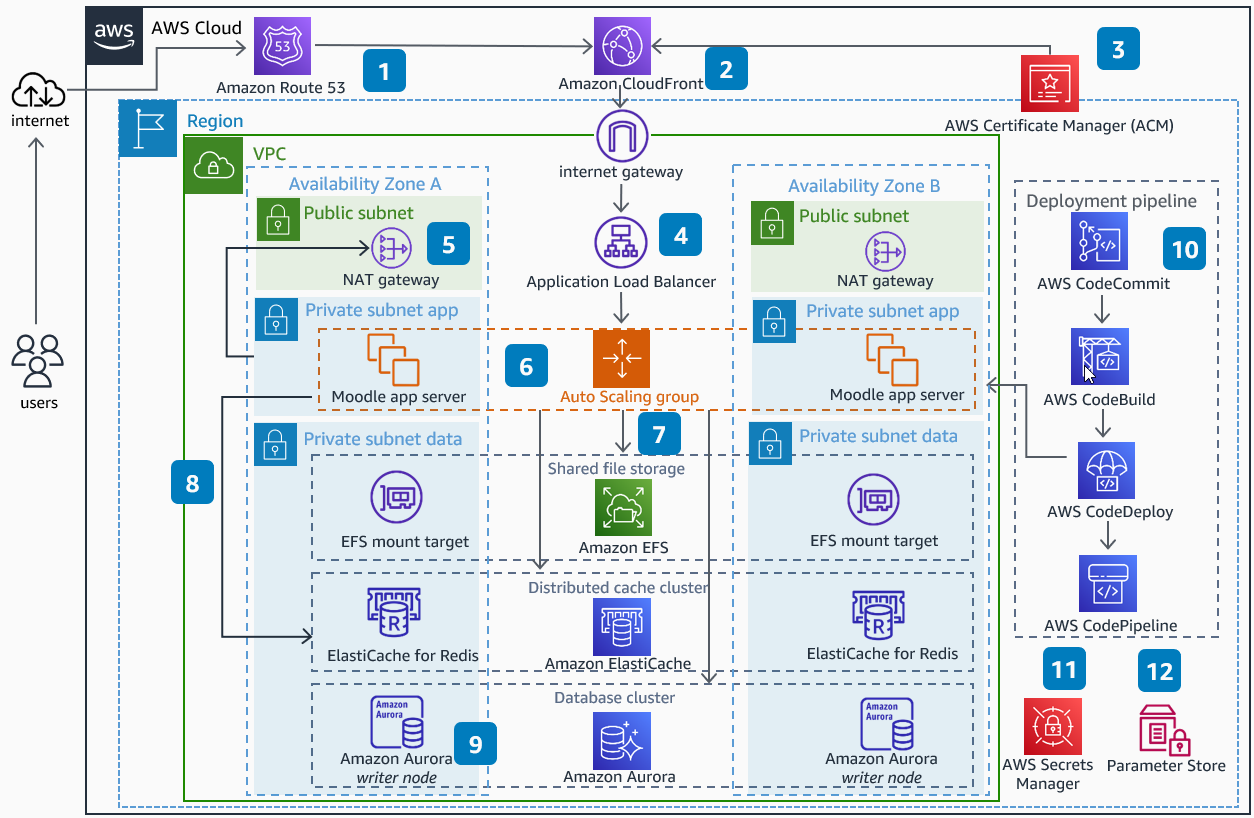
AWS has developed a reference architecture that is specifically designed for Moodle deployments that require high availability and flexibility.
There are several layers to the architecture.
1. Load Balancing Layer
Incoming user requests are distributed across multiple Moodle application servers using an Application Load Balancer (ALB).
Benefits include:
- Improved availability
- Better performance distribution
- Automatic failover
- Seamless scaling during traffic spikes
This layer ensures that no single Moodle server becomes overwhelmed during exams, course launches, or large training events.
2. Auto Scaling Moodle Application Servers
The Moodle application runs on multiple Amazon EC2 instances configured within an Auto Scaling Group. Key advantages:
- Automatic capacity adjustments
- High availability across multiple Availability Zones
- Reduced infrastructure management
- Consistent application performance
When student activity increases, additional servers can be launched automatically to maintain responsiveness.
3. Shared File Storage with Amazon EFS
Moodle stores course content, assignments, videos, and uploaded files within the Moodledata directory.
In a multi-server environment, all application servers need access to the same files.
Amazon Elastic File System (EFS) provides:
- Shared storage across all Moodle nodes
- Automatic scaling
- High durability
- Simplified file management
This eliminates file synchronization challenges often encountered in traditional clustered deployments.
4. Managed Database Layer
The database is one of the most critical components of Moodle.
AWS recommends using Amazon RDS for MySQL or MariaDB to provide:
- Automated backups
- Multi-AZ availability
- Automatic patching
- Database monitoring
- Disaster recovery capabilities
With managed database services, administrators can focus on platform improvements rather than database maintenance.
5. Secure Networking with Amazon VPC
Security is essential for educational and enterprise systems handling sensitive student and employee data.
The Moodle environment is deployed inside an Amazon Virtual Private Cloud (VPC) with:
Public subnets for load balancers
- Private subnets for application servers
- Isolated database infrastructure
- Controlled network access
This layered security approach minimizes exposure to external threats.
6. Monitoring and Logging
Operational visibility becomes increasingly important as systems grow.
Infrastructure health monitoring
- Application performance metrics
- Log aggregation
- Alerting and notification capabilities
Administrators can proactively identify issues before they impact learners.
Benefits for Large Educational Institutions
Organizations deploying Moodle on AWS gain several strategic advantages.
High Availability
Multi-AZ deployments ensure learning services remain accessible even if an infrastructure component fails.
Elastic Scalability
The platform can support seasonal demand spikes such as:
- Semester registrations
- Certification programs
- Online examinations
- Corporate compliance training
Reduced Operational Overhead
Managed services significantly reduce infrastructure administration requirements.
Improved Security
AWS security services help organizations meet compliance and data protection requirements.
Best Practices for Production Deployments
- Enable Auto Scaling for Moodle application servers.
- Use Multi-AZ database deployments.
- Store shared content on Amazon EFS.
- Configure automated backups.
- Implement Web Application Firewall (WAF) protection.
- Use HTTPS across all services.
- Monitor infrastructure continuously.
- Conduct periodic load testing.