Your workflow exists because of how your organization runs — not how Moodle expects it to.
Approval chains, grading rules, enrollment logic that's specific to you.
Standard Moodle gets you 80% of the way there. Then you hit the wall: a workflow no plugin supports, a report nobody can build, an integration that doesn’t exist. That wall is exactly where we come in.
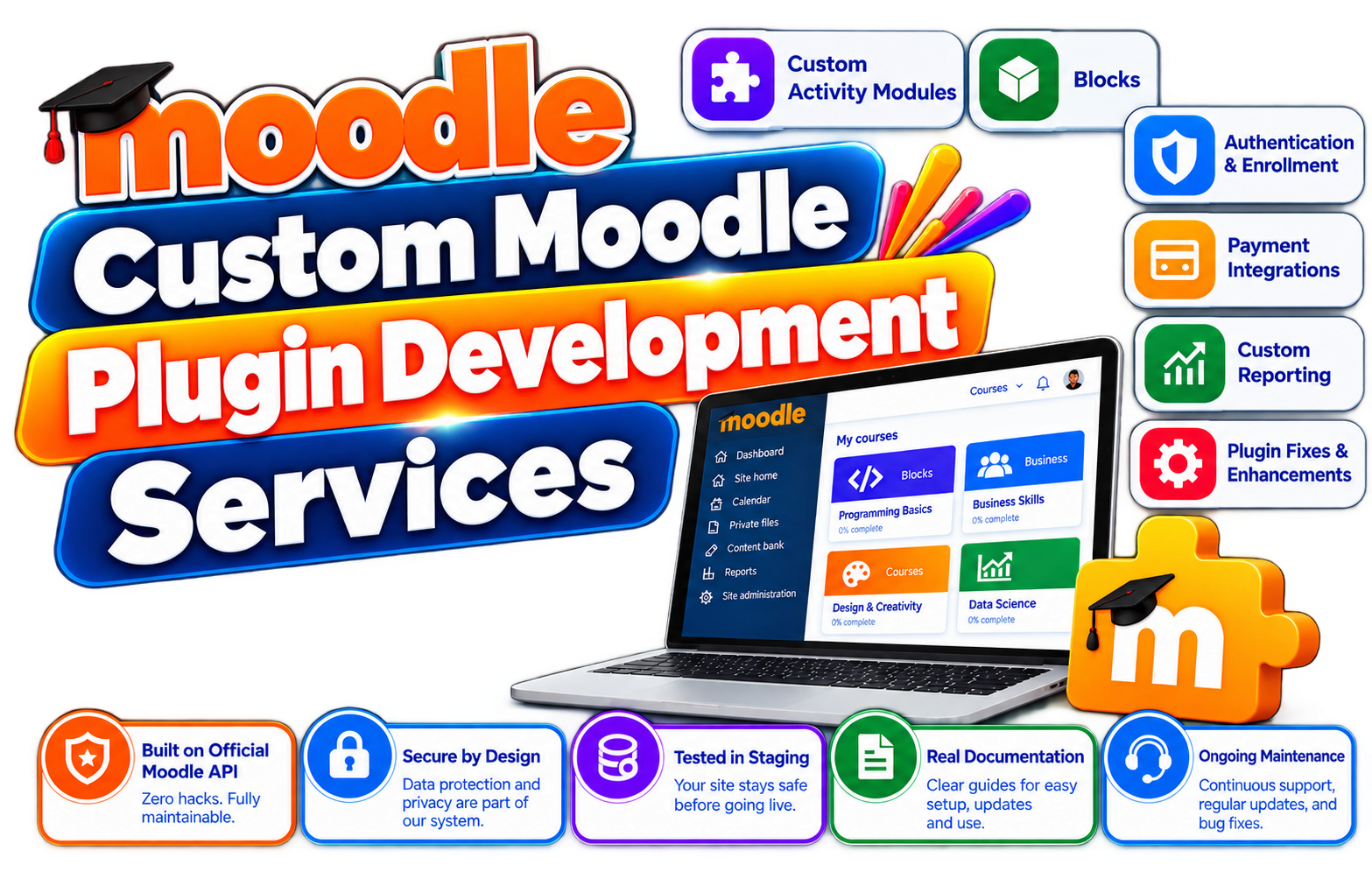
2PI Solutions builds Moodle plugins that do the thing your organization actually needs — not the closest thing available on the plugin directory. Activity modules, blocks, authentication, enrollment logic, payment integrations, custom reporting, or a fix to a plugin someone else left half-finished: we build it against Moodle’s own APIs, so it works today and keeps working after your next three upgrades.
No workarounds. No core file hacks that break on update day. Just code built to do exactly what you asked, the way Moodle expects it to be built.
Moodle's plugin directory is genuinely good. Most requirements are already solved by something free and well-maintained — and if that's your situation, we'll tell you so instead of selling you a custom build you don't need.
Approval chains, grading rules, enrollment logic that's specific to you.
Cross-course completion views, compliance exports in your format, dashboards built around the numbers your stakeholders actually ask for.
A CRM, an HRIS, a student information system, a payment processor — none of it connects natively.
Simulations, custom grading logic, interactive formats.
Enrollment triggered by hand, notifications sent one at a time, data copied between systems every week.
Any one of these on its own is a signal. Two or more, and you're not looking for a workaround anymore — you're looking for a plugin.
↗You're looking for a plugin.Anyone can write PHP that technically does what you asked. Fewer people write PHP that respects Moodle's architecture well enough to still be working in two years. That gap is where we operate.
Every plugin is developed and tested against your actual version and your actual installed plugins — so conflicts get caught in staging, not discovered by your users.
Capabilities and role-based permissions are part of the plugin from line one, because retrofitting security into finished code is how vulnerabilities happen.
Database schema, queries, and caching decisions are made with your actual course and user counts in mind — the difference matters enormously once you're past a few hundred active learners.
Every plugin is built against Moodle's documented APIs. That one discipline is the entire difference between a plugin that survives an upgrade and one you have to rebuild from scratch.
Configuration, expected behavior, admin instructions — handed over in a form your team can act on without calling us for every small change.
Maintenance support means your plugin gets reviewed and updated as Moodle ships new versions, instead of quietly breaking the day you least expect it.
Moodle's plugin architecture covers more ground than most teams realize. Here's where custom development actually pays off.

Custom activity and assessment types — simulations, interactive exercises, specialized assignment formats — wired into Moodle's gradebook and completion tracking exactly like native activities. Learners and instructors shouldn't be able to tell it's custom.

Blocks that put the right data in front of the right person on the right page: attendance at a glance, quick-action panels, KPI widgets for admins, announcements scoped to a course or role.

Backend muscle with no front-end presence — scheduled tasks, custom web services, internal tooling, the system-level logic that ties your other plugins together.

Login and SSO built around the identity system you already run, so users sign in the way your organization works — not the way Moodle assumes they will.

Enrollment triggered by whatever actually drives access in your world — a payment, an HR event, a completed prerequisite — instead of a person clicking "enroll" manually, every time, forever.

Plugins that connect Moodle to your payment gateway so access follows payment automatically. No manual enrollment step standing between a sale and a student getting in.

Connectors between Moodle and the systems you already run — CRM, ERP, HR, video conferencing — built through REST APIs, webhooks, or LTI.

Dashboards and reports built around the metrics your team actually tracks — completion trends, engagement, compliance — instead of a raw export somebody reformats by hand every single cycle.

Plenty of real requirements need pieces of several plugin types working together. If that's you, skip trying to categorize it yourself — just tell us the problem.
Building custom when you didn't need to is a waste of your budget. Here's how to know which situation you're actually in, fast.
Plugin work isn't only about Moodle in isolation — half the time, it's about making Moodle talk to systems it was never built to know about:
Enrollment and engagement data flows straight to sales and customer success, no manual export.
Enrollment tied automatically to onboarding, role changes, or compliance requirements.
Grades and enrollment sync without anyone re-typing a spreadsheet.
Access follows payment, immediately, without a human in the loop.
Users log in through the system your organization already trusts.
If a person is the integration right now, that's the tell.
We dig into what you're actually trying to achieve — not just the feature request — and check whether something already covers part of it.
We review your current setup and installed plugins to flag conflicts before a single line of code gets written.
We decide new build, customization, or a mix — and scope it honestly.
Built against Moodle's documented APIs and database layer. Core files stay untouched.
External connections get built and tested inside the same development cycle, not bolted on afterward.
Functional testing against the requirement, plus compatibility testing against everything else you've got installed.
The plugin runs in an environment that mirrors production before anyone signs off on it.
Rolled out with a rollback plan, so a production problem has a fast way back.
Configuration and expected behavior, written so your team can use it without calling us.
Ongoing review as Moodle ships new versions — the plugin doesn't get abandoned the day it goes live.
Custom code that ignores Moodle's own conventions is a liability wearing a working demo. Our standard is the same one Moodle's core team holds itself to:
no software is 100% secure, and nobody can truthfully promise every future Moodle release will work with a custom plugin without any review at all. What we do promise is building to minimize that friction, testing against real upgrade paths, and offering maintenance so plugins get checked — and fixed — the moment a new version ships.
A plugin that works in a demo and one that survives production traffic aren't always the same thing. Here's how we close that gap before your users find it for you:
build and iterate, isolated from anything live
tested against a real copy of your Moodle instance, plugins and all
does it do the job, and does it coexist with everything else installed
not a support ticket after
a fast, defined path back if something goes sideways
configuration, behavior, and admin instructions, handed over properly
reviewed and updated as your Moodle version changes, so support doesn't stop the day the plugin ships
An existing plugin doesn't fit your actual workflow, even after you've configured everything possible
You need reports or tracking Moodle's built-in tools just don't produce
Your platform needs to talk to a CRM, ERP, payment gateway, or internal system it currently can't reach
You need an assessment type the standard quiz and assignment modules can't express
Enrollment should trigger automatically — from a payment, an HR event, a prerequisite — instead of someone clicking a button
You're paying a person to do work a plugin could automate in seconds
Your requirement is specific enough to your organization that no generic plugin was ever going to solve it
That's worth a conversation before you burn more time forcing a fit that isn't there.
Built around the way your Moodle environment actually works — not around the limitations of an off-the-shelf plugin.
Not a workflow bent to fit someone else's plugin.
Because the plugin does automatically what a person was doing by hand.
Instead of a raw export reformatted every cycle.
Cutting duplicate entry and the errors that come with it.
For instructors and learners — no friction, no "this feels bolted on".
So performance holds as your course and user counts grow.
Because it's documented and built on Moodle's own APIs instead of a clever hack nobody else understands.
We're not going to hand you a number here, because an honest one doesn't exist without understanding your requirement — anyone quoting flat pricing before that conversation is guessing, and you shouldn't trust a guess with your budget. What genuinely drives cost:
A straightforward report plugin and a custom activity type with its own grading logic are entirely different projects
A plugin that does one thing well costs less than one trying to solve five problems at once
A backend-only local plugin is simpler than something needing a full admin interface
Connecting to an external system adds real scope beyond what happens inside Moodle
New tables, complex queries, or high-volume data change the engineering effort
Role-based access is worth building right, and that takes real work
Exports, dashboards, and scheduled reports each add scope
How much is riding on this plugin working correctly the first time
Extending something 80% finished is almost always cheaper than starting from zero
Whether updates are bundled in as Moodle evolves, or handled separately
Tell us the actual problem and we'll give you a real number based on your real requirement — not a range pulled out of thin air.
Custom Moodle plugins make the most sense when your organization has workflows that standard configurations simply cannot handle.
Automating enrollment, compliance tracking, and reporting across a workforce that's too large for manual admin work to keep up with.
Connecting Moodle to student information systems, library platforms, or workflows specific to how the institution actually runs — not how a generic training program runs.
Running assessment logic, credentialing, or payment flows that standard e-commerce plugins were never built to handle, especially where a credential's validity is on the line.
If your Moodle instance needs a workflow, report, or integration that's specific to you — that's the signal you're looking at custom plugin work, not a bigger settings change.
If your requirement involves deeper enhancements, we combine plugin development with safe customization and core extensions in Moodle-based systems.

We have partnered with 2PI Solutions for three years now and value their consistency, technical expertise, and deep understanding of our ecosystem. Their successful integration of our off-grid learning devices with our cloud infrastructure ensured secure, seamless synchronization with our LMS. Their flexibility and reliability make them a trusted long-term partner for scalable, future-ready technology.

We have been working closely with 2PI Solutions for five years, and their consistency, technical expertise, and understanding of our ecosystem have been exceptional throughout the engagement. They delivered a reliable solution that ensures seamless, secure synchronization of the device content with our LMS across environments. We value their flexibility, which gives us greater operational control. 2PI Solutions is a trusted, long-term partner we rely on for scalable and future-ready technology.

We’ve been using 2PI Solutions for approximately 5 years now to help manage and maintain our LMS. We couldn’t be more pleased with their efforts! Their availability and response time has always been excellent, and their expertise and problem-solving skills are top notch! I look forward to working with them for years to come.
We employ PHP, Moodle APIs, database best practices, and secure coding practices to develop robust and future-proof plugins.
A Moodle plugin is an extension that adds new features or alters existing functionality without altering core files.
Yes. We adhere to Moodle’s official plugin development guidelines to guarantee upgrade compatibility.
Yes. We can improve or alter existing plugins if they meet your needs.
Depending on complexity, development may take anywhere from a few days to a few weeks.
Yes. We provide support for testing, deployment, and maintenance.
Absolutely. We develop plugins that interface with CRMs, ERPs, payment gateways, and other APIs.
Yes. Security and performance optimization are integral parts of our development process.
Any organization with unique learning processes, reporting requirements, or integration requirements can benefit from custom plugins.