Blogs

Institutions are always searching for methods to enhance learning opportunities, boost student engagement, and lessen administrative burdens in the ever changing world of digital education. The way online learning platforms function is changing due to the emergence of artificial intelligence (AI), a game-changing technology. AI can greatly improve instruction, learning, and course administration when used with Moodle.

This article examines how AI might assist Moodle users in developing more intelligent, customised, and productive learning environments.

What Is Moodle?

One of the most popular learning management systems (LMS) in the world is Moodle. Moodle is used by corporations, educational institutions, and training organisations to develop, administer, and deliver online courses. It is a popular option for eLearning all over the world due to its adaptability, open-source nature, and vast plugin ecosystem.

AI integration with Moodle presents new prospects to enhance learner outcomes and instructor productivity as educational needs continue to expand.

1. Personalized Learning Experiences

Each learner learns in a unique way. Regardless of a student’s learning speed or degree of expertise, traditional online courses frequently offer the same content to all students.

To develop individualized learning routes, AI can examine student behavior, quiz scores, assignment performance, and engagement trends. Moodle can suggest particular materials, exercises, or tests based on these insights that are suited to the requirements of each student.

This individualized strategy aids students in maintaining their interest, overcoming obstacles to learning, and improving their academic performance. 

2. Automated Grading and Instant Feedback

It might take a lot of time to grade assignments and tests, particularly in large classes.

Quizzes, objective tests, and some writing assignments can all be automatically graded by AI-powered grading systems. Without having to wait for instructor critiques, students can find areas for development because they receive immediate feedback on their performance.

Automated grading frees up teachers’ time for curriculum creation, coaching, and instruction by reducing administrative duties.

3. AI-Generated Course Content

It takes a lot of work and skill to produce educational content of the highest caliber. AI can help educators by producing:

  • Outlines of courses
  • Summaries of lessons
  • Questions for a test
  • Topics for discussion
  • Learning goals
  • Study aids

Teachers can utilize AI-generated drafts as a starting point and modify them in accordance with course requirements instead of beginning from scratch. This preserves the quality of the content while speeding up the construction of courses.

4. Intelligent Student Support Through Chatbots

Students frequently require help after regular business hours. Chatbots with AI capabilities that are linked with Moodle can offer round-the-clock assistance by responding to frequently asked queries about:

  • Timetables for courses
  • Deadlines for assignments
  • Educational resources
  • Technical problems
  • Enrolment processes

Quick responses lessen the workload for teachers and support staff while also enhancing the student experience.

5. Advanced Learning Analytics

AI’s capacity to swiftly and precisely evaluate vast volumes of data is one of its biggest advantages.

  • Moodle’s AI-powered analytics can assist teachers in:
  • Early detection of troubled students
  • Track the degree of engagement
  • Monitor the rates of course completion.
  • Identify any gaps in knowledge
  • Evaluate the success of training

Proactive actions that enhance academic achievement and student retention are made possible by these findings.

6. Enhanced Accessibility and Inclusivity

Modern education requires the creation of an inclusive learning environment.

AI can help with accessibility by offering:

  • Automatic captioning for videos
  • Transcription from speech to text
  • Text-to-speech capabilities
  • Translation of languages
  • Tools for reading help

Students with disabilities and those from a variety of language backgrounds can study more easily thanks to these characteristics.

7. Smarter Assessments and Adaptive Learning

Individual learning demands are frequently not met by traditional assessments. Adaptive tests driven by AI have the ability to dynamically modify question difficulty in response to student answers.

For instance, students who show a high level of comprehension can be given more challenging questions, while those who are having trouble grasping the material might be given more help and easier tasks.

This method encourages ongoing development and offers a more accurate assessment of students’ understanding.

8. Improved Academic Integrity

In online learning, upholding academic integrity can be difficult.

AI technologies can assist in identifying:

  • Plagiarism
  • Repeated submissions
  • Untrustworthy evaluation practices
  • Possible patterns of dishonesty

Institutions can maintain academic standards and guarantee impartial evaluation procedures by spotting anomalies early.

9. Better Course Recommendations

AI can suggest pertinent courses and learning opportunities by analysing student interests, learning histories, and performance data.

These tailored suggestions promote lifelong learning and assist students in finding material that supports their academic and professional objectives.

10. Increased Efficiency for Educators

In addition to enhancing student performance, AI simplifies numerous administrative duties, such as:

  • Organization of content
  • Monitoring attendance
  • Monitoring progress
  • Reporting on performance
  • Management of communication

Because of this efficiency, teachers may concentrate more on providing high-quality instruction and helping students.

The Future of AI in Moodle

The importance of AI in Moodle is anticipated to grow dramatically as the technology develops. Predictive learning models, intelligent tutoring programs, sophisticated content creation, and highly customised educational experiences are examples of potential future possibilities.

Businesses will be in a better position to provide interesting, scalable, and successful online learning programs if they adopt AI-enhanced Moodle settings.

Conclusion

Moodle is becoming a more intelligent and potent learning platform thanks to artificial intelligence. AI assists educators in providing more effective learning experiences while lowering administrative burdens, from intelligent analytics and student support to personalised learning paths and automated grading.

AI integration with Moodle can give businesses and educational institutions a major competitive edge as they continue to use digital learning solutions. Organisations can increase learner engagement, improve educational results, and get ready for the future of online education by utilising AI-driven tools and insights.

Cloud Migration Services, Managed Cloud Services

A highly scalable Learning Management System (LMS) is necessary for expanding educational institutions, online learning platforms, and corporate training departments. Although Moodle is an open-source LMS and widely used, a strong infrastructure would be required to support thousands of concurrent users. Thanks to Amazon Web Services (AWS), Moodle can be implemented in a secure, flexible, and easily available manner. By using this design, institutions can ensure that they have a significant number of students, teachers and administrators without compromising performance, dependability or operational effectiveness.'”.

Why Traditional Moodle Deployments Struggle at Scale

Initially, several organizations opt to use Moodle on a single virtual machine. Although this setup is effective for small teams, it often encounters difficulties as its usage increases: During peak usage, the page may experience slow loading times.

Slow page loading during peak usage

  1.  Limited storage scalability.
  2.  Single points of failure.
  3.  Database bottlenecks.
  4.  Managing an excessive number of concurrent individuals.
  5.  Uncomplicated backup and disaster recovery strategies.?

A robust architecture that can adapt to the changing demand is essential, especially for large universities, online training providers, and enterprise learning platforms.

Enterprise Moodle Architecture on AWS


AWS has developed a reference architecture that is specifically designed for Moodle deployments that require high availability and flexibility.
There are several layers to the architecture.
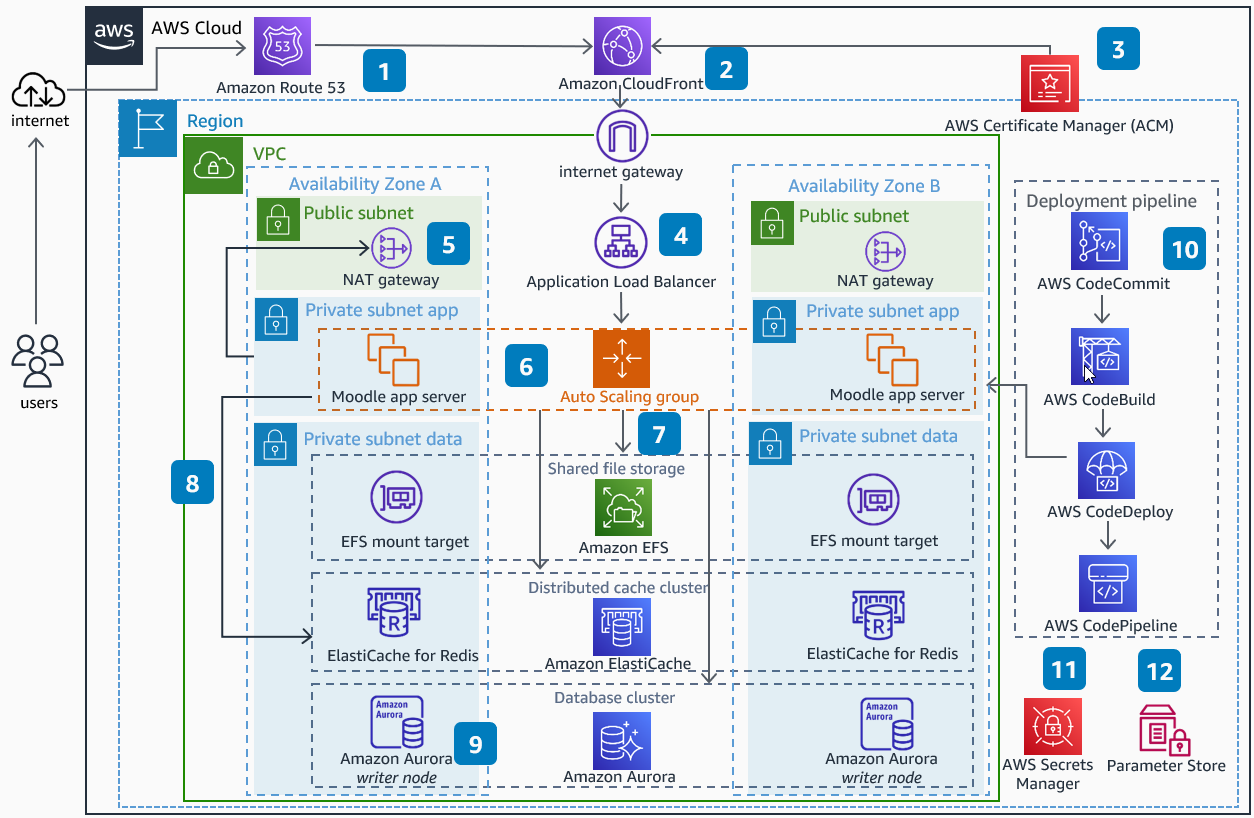
Moodle Infrastructure AWS

1. Load Balancing Layer
Incoming user requests are distributed across multiple Moodle application servers using an Application Load Balancer (ALB).

Benefits include:

  • Improved availability
  • Better performance distribution
  • Automatic failover
  • Seamless scaling during traffic spikes

This layer ensures that no single Moodle server becomes overwhelmed during exams, course launches, or large training events.

2. Auto Scaling Moodle Application Servers

The Moodle application runs on multiple Amazon EC2 instances configured within an Auto Scaling Group. Key advantages:

  • Automatic capacity adjustments
  • High availability across multiple Availability Zones
  • Reduced infrastructure management
  • Consistent application performance

When student activity increases, additional servers can be launched automatically to maintain responsiveness.

3. Shared File Storage with Amazon EFS

Moodle stores course content, assignments, videos, and uploaded files within the Moodledata directory.
In a multi-server environment, all application servers need access to the same files.
Amazon Elastic File System (EFS) provides:

  • Shared storage across all Moodle nodes
  • Automatic scaling
  • High durability
  • Simplified file management

This eliminates file synchronization challenges often encountered in traditional clustered deployments.

4. Managed Database Layer
The database is one of the most critical components of Moodle.

AWS recommends using Amazon RDS for MySQL or MariaDB to provide:

  • Automated backups
  • Multi-AZ availability
  • Automatic patching
  • Database monitoring
  • Disaster recovery capabilities

With managed database services, administrators can focus on platform improvements rather than database maintenance.

5. Secure Networking with Amazon VPC

Security is essential for educational and enterprise systems handling sensitive student and employee data.
The Moodle environment is deployed inside an Amazon Virtual Private Cloud (VPC) with:

    Public subnets for load balancers  

  • Private subnets for application servers
  • Isolated database infrastructure
  • Controlled network access

This layered security approach minimizes exposure to external threats.

6. Monitoring and Logging

Operational visibility becomes increasingly important as systems grow.

Infrastructure health monitoring

  • Application performance metrics
  • Log aggregation
  • Alerting and notification capabilities

Administrators can proactively identify issues before they impact learners.

Benefits for Large Educational Institutions

Organizations deploying Moodle on AWS gain several strategic advantages.

High Availability

Multi-AZ deployments ensure learning services remain accessible even if an infrastructure component fails.

Elastic Scalability

The platform can support seasonal demand spikes such as:

  • Semester registrations
  • Certification programs
  • Online examinations
  • Corporate compliance training

Reduced Operational Overhead

Managed services significantly reduce infrastructure administration requirements.

Improved Security

AWS security services help organizations meet compliance and data protection requirements.

Best Practices for Production Deployments

  1. Enable Auto Scaling for Moodle application servers.
  2. Use Multi-AZ database deployments.
  3. Store shared content on Amazon EFS.
  4. Configure automated backups.
  5. Implement Web Application Firewall (WAF) protection.
  6. Use HTTPS across all services.
  7. Monitor infrastructure continuously.
  8. Conduct periodic load testing.


How AI Is Transforming Learning Management Systems in 2026
Learning Management Systems are undergoing their most significant transformation since their inception. What began as content repositories has evolved into intelligent learning ecosystems. By 2026:
  • Over 75% of enterprises are expected to use AI-driven learning tools
  • Organisations report 30-40% reduction in training administration effort using automation
  • Personalised learning increases learner completion rates by up to 60%
2015 Content hosting, basic tracking
2018 Mobile learning, video-based courses
2021 Cloud LMS, analytics dashboards
2024 AI recommendations, automation
2026 Predictive learning, skill intelligence, AI orchestration
LMS platforms in 2026 function as decision-support systems, not just learning tools.

1. AI-Powered Personalisation: From Courses to Learning Journeys

Traditional LMS platforms deliver the same content to every learner. AI-powered LMS platforms analyse:
  • Learning behaviour
  • Assessment performance
  • Role-based skill requirements
  • Engagement patterns

What changes in 2026:

  • Dynamic learning paths update automatically
  • Content recommendations adjust in real time
  • Learners spend less time searching and more time learning
Personalised learning platforms report 20–35% faster skill acquisition compared to static LMS models.  

2. Automation: Solving the Hidden Cost of Training

Training teams spend a surprising amount of time on manual tasks:
  • Enrolments
  • Reminders
  • Certifications
  • Reports
  • Compliance tracking
AI-enabled automation eliminates these inefficiencies.

Impact:

  • Automated enrolment & role mapping
  • Smart notifications & nudges
  • Auto-generated compliance reports
Organisations using LMS automation save an average of 25–40% operational time annually.

3. Learning Analytics: Turning Data into Decisions

Most LMS platforms collect data — few turn it into insight. AI-driven analytics provide:
  • Learner risk prediction
  • Skill gap identification
  • Content effectiveness scoring
  • Training ROI visibility
Companies using learning analytics are 2x more likely to align training with business outcomes.  

4. Predictive Learning & Workforce Readiness

In 2026, LMS platforms are shifting from reactive learning to predictive learning:
  • Identifying learners likely to disengage
  • Recommending interventions early
  • Forecasting skill shortages
  Predictive learning systems reduce dropout rates by up to 45%.  

5. Engagement Through Intelligent Design

AI optimises:
  • Microlearning formats
  • Adaptive assessments
  • Spaced repetition
  • Timely nudges
  Microlearning improves retention by 20%+ compared to long-form modules.

Why AI LMS Is No Longer Optional in 2026

AI-powered LMS platforms deliver:
  • Faster skill readiness
  • Lower training costs
  • Higher learner satisfaction
  • Stronger business alignment
Organisations that delay adoption risk falling behind in workforce capability.  

FAQs

How does AI improve LMS outcomes? By personalising learning, automating operations, and providing actionable insights.

Is AI LMS only for large enterprises? No. Scalable AI LMS platforms support SMBs, enterprises, and institutions alike.

Does AI replace instructors? No – it enhances instructor effectiveness.

 
From Traditional LMS to Intelligent LMS-What Businesses Need to Know
For years, Learning Management Systems (LMS) have been the backbone of corporate and institutional learning. However, as business environments, skill requirements, and learner expectations evolve, traditional LMS platforms are no longer sufficient. Today, organisations are moving toward intelligent LMS platforms -systems that do more than deliver content. They analyse behaviour, automate processes, and actively support learning outcomes.

1. The Role of Traditional LMS – And Where It Breaks Down

Traditional LMS platforms were originally designed to:
  • Host learning content
  • Track course completions
  • Manage basic assessments
  • Generate standard reports 
While these functions remain important, they are no longer enough.

Common Challenges with Traditional LMS

  • Static, one-size-fits-all learning experiences
  • Heavy reliance on manual administration
  • Limited insights into learner behaviour
  • Low engagement and completion rates
  • Poor alignment with business outcomes
More than 60% of organisations report dissatisfaction with legacy LMS platforms due to low engagement and limited reporting capabilities.  

2. What Is an Intelligent LMS?

An intelligent LMS goes beyond content delivery. It uses AI, automation, and advanced analytics to actively support learning and business goals.

Core Characteristics of an Intelligent LMS

  • AI-driven personalisation
  • Automated learning workflows
  • Predictive analytics
  • Skill-based learning intelligence
  • Real-time performance insights
Instead of reacting to learning activity, an intelligent LMS anticipates needs and recommends actions.

3. Key Differences: Traditional LMS vs Intelligent LMS

 
Area Traditional LMS Intelligent LMS
Learning Experience Static Personalised & adaptive
Administration Manual Automated
Analytics Basic reports Predictive insights
Engagement Low to moderate High & data-driven
Scalability Limited Enterprise-ready
Business Alignment Weak Strong
  Organisations using intelligent LMS platforms report up to 50% higher learner engagement compared to traditional systems.  

4. Business Benefits of Moving to an Intelligent LMS

4.1 Faster Skill Development

AI-driven recommendations ensure learners receive the right content at the right time, reducing time-to-competency. Skill acquisition speeds improve by 25-40% with personalised learning paths.

4.2 Reduced Administrative Overhead

Automation handles:
  • Enrolments
  • Notifications
  • Certifications
  • Compliance tracking
  • Reporting
Training teams save 30-45% of operational time annually.

4.3 Better Decision-Making with Learning Analytics

Intelligent LMS platforms provide insights into:
  • Skill gaps
  • Learner risk
  • Content effectiveness
  • Training ROI
Data-driven learning organisations are 2× more likely to align training with business objectives.

4.4 Improved Learner Engagement & Retention

Through adaptive content, microlearning, and timely nudges, intelligent LMS platforms keep learners motivated. Completion rates improve by 20-60%, depending on learning design.

5. Scalability and Flexibility for Growing Organisations

Modern organisations require learning platforms that scale:
  • Across departments
  • Across geographies
  • Across learning models (corporate, academic, hybrid) 
Intelligent LMS platforms are built on flexible architectures that support growth without system disruption. Scalable LMS adoption reduces future platform migration costs by up to 40% over five years.  

6. When Should Businesses Upgrade to an Intelligent LMS?

An upgrade is worth considering if:
  • Learner engagement is consistently low
  • Administrative workload is high
  • Training impact is difficult to measure
  • Skills are changing faster than content updates
  • The LMS no longer supports business growth 

7. How to Transition Successfully

A successful transition requires:
  1. Clear learning and business objectives
  2. Data and content migration planning
  3. Stakeholder alignment
  4. Change management and user training
  5. Ongoing optimisation using analytics 
The goal is not just to replace technology, but to elevate learning strategy.  

FAQs

What makes an LMS “intelligent”? An intelligent LMS uses AI, automation, and analytics to personalise learning, reduce manual effort, and provide predictive insights. Is an intelligent LMS suitable for small organisations? Yes. Modern intelligent LMS platforms are scalable and support organisations of all sizes. Does switching LMS platforms disrupt learning? With proper planning and phased implementation, disruption can be minimal.
Top eLearning Trends Organisations Must Prepare for in the Next 3 Years
Learning is no longer an HR function – it is a business growth driver. Companies that invest in continuous learning are 46% more likely to outperform competitors.

1. AI-First Learning Platforms

AI is becoming the core architecture of LMS platforms.

What’s changing:

  • Intelligent recommendations
  • Automated learning journeys
  • Adaptive assessments
By 2028, 80% of digital learning platforms will include AI-driven personalisation.

2. Shift to Skills-Based Learning

Course completion is losing relevance. Skills are the new currency.

Organisations are focusing on:

  • Skill mapping
  • Competency frameworks
  • Role-based learning
Skills-based learning improves workforce agility by 30%+.  

3. Microlearning & Just-in-Time Learning

Employees prefer learning that fits into work – not disrupts it. Microlearning increases knowledge retention by up to 80% when delivered contextually.  

4. Automation of Learning Operations

Automation will dominate:
  • Compliance tracking
  • Reporting
  • Certification renewals
Automated LMS platforms reduce training administration costs by 35-45%.  

5. Data-Driven Learning Strategy

Learning decisions will increasingly be based on analytics, not assumptions. Data-driven organisations are 3x more likely to improve learning ROI.  

Preparing for the Next 3 Years

To stay competitive, organisations must:
  • Adopt AI-enabled LMS platforms
  • Focus on skills, not content volume
  • Use data to guide learning investments